
OLSAT Level G is typically associated with Grades 9–12. OLSAT Level G is the typical high-school level for ninth through twelfth grades. Practice includes precise word meanings, logical deductions, visual transformations, and number relationships. Careful interpretation matters as much as recognizing a pattern. Confirm the assigned level and form with your school before choosing practice.
OLSAT Level G infographic
Explore the guide together, then try the four original examples. Open the full-size image to read the smaller details; the key information and explanations are also available as text below.
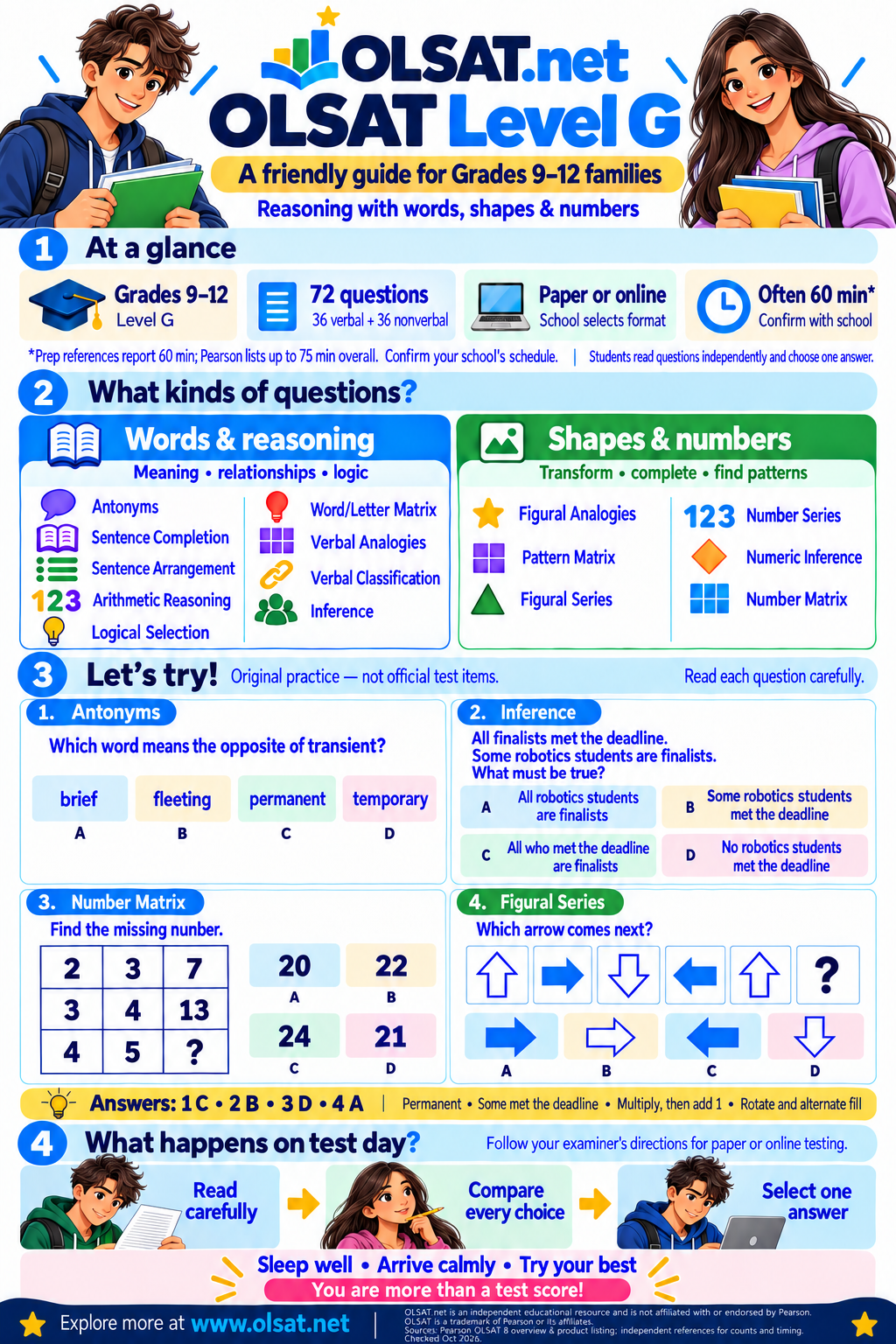
Open the full-size Level G infographic · Compare all OLSAT levels
Level G format, question count, and timing
- Typical grade match: Grades 9–12.
- Commonly reported length: 72 questions, with 36 verbal and 36 nonverbal.
- Delivery: Paper or online; ask the school which format and directions apply.
The infographic shows an often-reported 60-minute estimate. A university guide plans 60 minutes including preparation, while Pearson describes untimed completion up to 75 minutes overall. Obtain the schedule and administration details directly from the school. The infographic’s counts are commonly reported preparation figures, not a verified specification for every current official form. Our question-count and timing FAQ explains the source differences and practice settings.
What question types are included at Level G?
Verbal reasoning and comprehension
Antonyms · Sentence Completion · Sentence Arrangement · Arithmetic Reasoning · Logical Selection · Word/Letter Matrix · Verbal Analogies · Verbal Classification · Inference.
Pay attention to qualifiers such as all, some, and must. Keep the direction of an inference intact. In a visual series, check rotation and fill separately; in a matrix, verify a proposed operation across every complete row.
Nonverbal reasoning
Figural Analogies · Pattern Matrix · Figural Series · Number Series · Numeric Inference · Number Matrix.
Track changes in shape, position, size, shading, and number. Quantitative reasoning is grouped within the nonverbal domain in Pearson’s scope chart; Arithmetic Reasoning is listed under verbal reasoning. The list follows the publisher’s level scope rather than equal quotas for each type.
The infographic’s four examples explained
These simplified, independently created examples teach a method. They do not reproduce secure OLSAT questions or represent the full difficulty range of a test form.
- Antonyms: Which word means the opposite of transient? Answer C. Transient means temporary or short-lived; permanent is its opposite.
- Inference: All finalists met the deadline. Some robotics students are finalists. What must be true? Answer B. Some robotics students met the deadline. Nothing establishes that all robotics students are finalists or that everyone who met the deadline is a finalist.
- Number matrix: The rows are 2, 3, 7; 3, 4, 13; and 4, 5, blank. Find the missing number. Answer D. Multiply the first two numbers and add one: 4 × 5 + 1 = 21. The same rule works in both complete rows.
- Figural series: Outlined up arrow, filled right arrow, outlined down arrow, filled left arrow, outlined up arrow: what comes next? Answer A. Turn clockwise at each step and alternate outline with fill. Next is a filled right arrow.
How to prepare for OLSAT Level G
Try several task families and record the reason for each error. Review the rule before checking the answer key, then explain why a distractor cannot be supported. Add longer practice once unfamiliar directions and task formats feel comfortable. Begin without a timer so the reasoning is clear. If you later use a timed OLSAT.net simulation, remember that its countdown is a practice setting rather than a universal official limit.
Start with free practice and select Level G. For structured member practice, explore grade-based OLSAT Practice Passes. Families with an assigned pass can continue from My Practice. Grades 9–12 preparation guide.
Before test day
- Confirm the level, form, paper or online delivery, and how directions will be presented.
- Ask about the session length, breaks, materials, and any agreed accommodations.
- Keep normal sleep and meal routines; leave time to arrive calmly.
- Encourage careful listening or reading, checking every choice, and selecting one answer as instructed.
Common Level G question
Does a Level G practice result give an official percentile?
No. OLSAT.net practice results show performance on original learning questions. They are not normed School Ability Index scores or official percentiles, and they do not determine admission or gifted-program eligibility.
A practice percentage is a learning snapshot. To understand the school’s report, read our OLSAT scores guide and ask how local decisions use the results.
Sources and review: Grade matches and question-type scope: Pearson OLSAT 8 overview brochure. General format and untimed guidance: Pearson product overview. Commonly reported counts: TestPrep-Online’s independent count table. Administration planning: University of Missouri administration guide. Reviewed October 7, 2026. OLSAT.net is independent and is not affiliated with or endorsed by Pearson.