
An official OLSAT 8 report may include a School Ability Index (SAI), percentile rank, stanine, and other measures. The report and the school’s own explanation are the right starting points for interpretation. A raw number from a short online practice activity is not comparable with those normed scores.
Common report terms
- School Ability Index: An age-based standardized score used by the publisher. Read it with the official report guidance.
- Percentile rank: A comparison with a specified norm group. It is not a percentage of questions answered correctly.
- Stanine: A broad nine-band summary of relative standing.
- NCE: A normalized comparison scale sometimes included in reports.
Ask about the decision, not just the number
Which norm group and test level were used? Does the school use the OLSAT result alone or with other evidence? What support is available for the student’s learning needs? Local policies differ, so avoid applying a cutoff found for a different district.
Take these questions to the school →
Source: Pearson OLSAT 8 product overview and Pearson OLSAT 8 scope-and-sequence brochure. OLSAT.net is an independent educational resource; examples here are original and are not official test questions.
Raw performance and normed scores are different
A raw score counts performance on a particular set of items. A percentile rank compares a score with a defined group. A short OLSAT.net learning activity is neither a normed score nor an estimate of a School Ability Index. Read the official score report’s labels and norm group before comparing numbers.
Gifted identification is local
A district may have a threshold, several pathways, or a broader review process. Read the gifted score guide and ask for the local written policy rather than applying a number from another school system.
See the visual guide
Open the infographic page for a full text explanation, sources, and a downloadable image.
Read OLSAT Score Report Infographic: Four Questions for Parents and transcript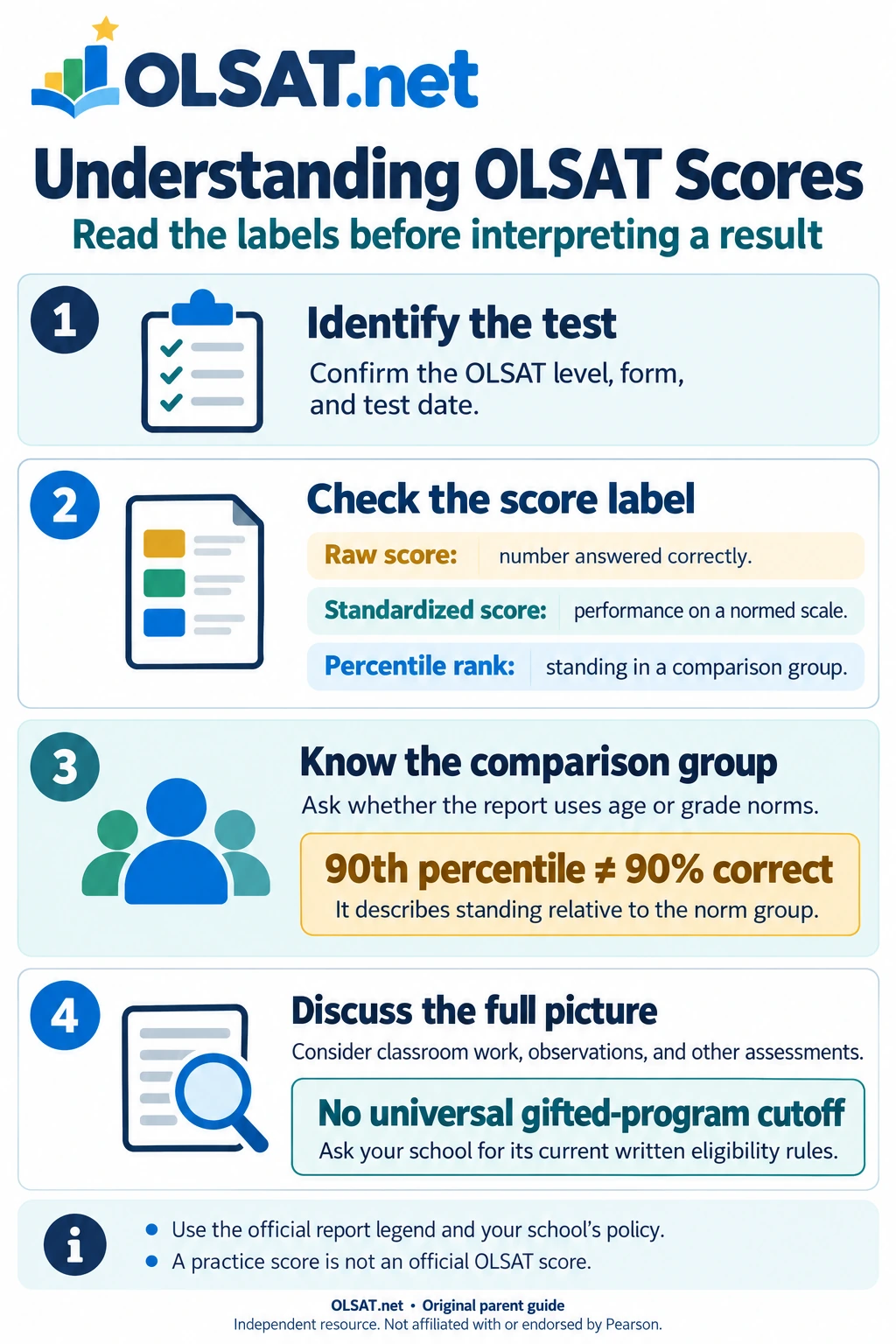
OLSAT percentile example: 90th percentile is not 90% correct
If a report gives a percentile rank of 90, the result is around the 90th percentile of the comparison group named on that report. It does not mean the student answered 90% of the questions correctly. Check whether the report uses age norms or grade norms before comparing results. The same raw performance can be interpreted differently when the comparison group changes.
How to read an OLSAT score report, step by step
- Identify the assessment. Note the test edition, administered level, test date, and whether the report describes the total or a particular reasoning area.
- Find the score label. Keep School Ability Index, percentile rank, stanine, and raw performance separate. They describe different aspects of the result.
- Check the comparison group. Look for age-based or grade-based norms and any explanatory notes from the publisher or school.
- Read the complete profile. If separate verbal and nonverbal results are provided, discuss both rather than relying only on the total.
- Read the local policy. Ask which score the program uses, whether other evidence is considered, and what follow-up options are available.
What is a good OLSAT score?
A useful answer depends on the purpose of testing and your school’s current criteria. A score can help a school understand learning needs even when it is not used for gifted identification. There is no single national pass score or gifted admission cutoff that applies to every district. Ask for the written criteria for the specific program and school year.
Can a practice result be converted into an SAI or percentile?
No. An official score uses the publisher’s scoring and norming procedures. Getting 8 out of 10 questions right on our free OLSAT practice test means 80% correct on that small exercise set only. It cannot be converted into an official SAI, percentile, IQ estimate, or probability of placement.
Questions to ask after receiving results
- Which reported score and norm group are used for eligibility?
- Were there circumstances during testing that should be discussed?
- What does the result suggest about classroom support or enrichment?
- If I disagree with a decision, what review process and deadlines apply?
Use our school discussion checklist and gifted eligibility guide to prepare for that conversation. For definitions and reporting options, see Pearson’s OLSAT 8 product information.