
Families often ask what OLSAT score is “gifted.” There is no single national OLSAT cutoff that qualifies a child everywhere. Schools and districts set their own identification rules and may use the OLSAT with achievement data, classroom work, teacher observations, or other evidence.
Read the official report first
Find the student’s test level, comparison group, score type, and any confidence or interpretive notes on the report. A percentile rank is a comparison with a norm group; it is not the percentage of questions answered correctly. A School Ability Index is a standardized score, not an IQ diagnosis or a practice-test percentage.
Ask about the local decision rule
- Which score or combination of scores does the program consider?
- Does it use age or grade norms, and which comparison group?
- Are there multiple routes to consideration?
- How are language background, disability, and access needs handled?
- Can families request a review or submit other evidence?
What to do next
Use the score terms guide to understand the report, then ask the school how the result relates to its written policy. An OLSAT.net practice result cannot estimate eligibility.
Assessment source: Pearson OLSAT 8 scope and sequence. Examples and illustrations on this page are independently created by OLSAT.net, not publisher items. Your school can confirm its actual level and administration plan.
See the visual guide
Open the infographic page for a full text explanation, sources, and a downloadable image.
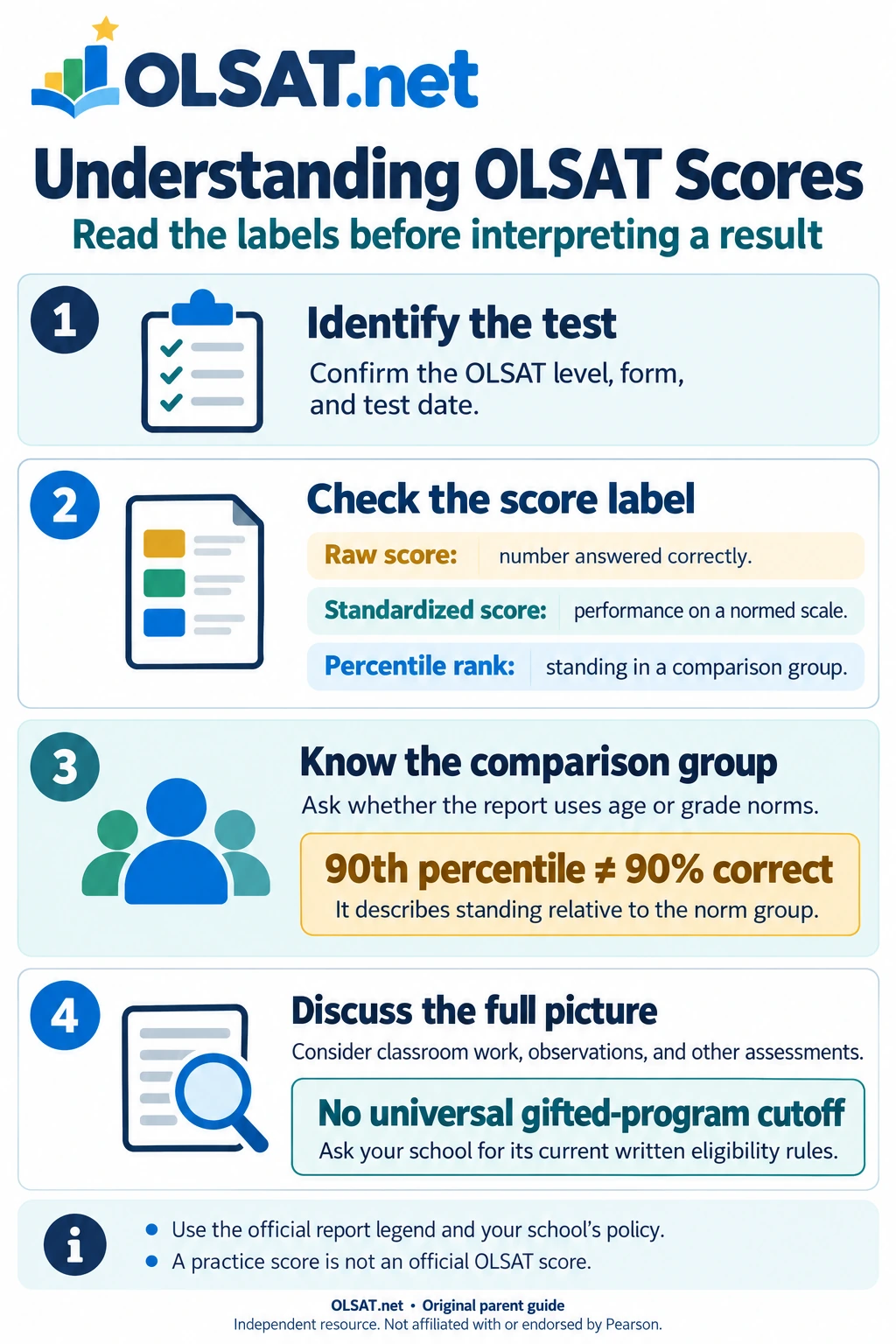
Read OLSAT Score Report Infographic: Four Questions for Parents and transcript