
OLSAT 8 has seven levels, A through G. Pearson lists paper administration from Kindergarten through Grade 12 and online administration from Grade 2 through Grade 12. The assessment is untimed; completion varies by level and Pearson lists a maximum of 75 minutes.
Three broad content areas
Verbal: Listening, word meaning, sentence relationships, and verbal logic. Nonverbal: Picture and figure relationships, series, and matrices. Quantitative: Number patterns, numerical relationships, and arithmetic reasoning. Pearson’s scope-and-sequence chart identifies which item types occur at which levels; do not assume every type appears on every test.
Why school details matter
Administration can be individual or in groups, online or on paper. Ask the school which level and form are planned, whether directions are read aloud, whether accommodations are available, and how long the local session usually takes.
Explore original examples by question family →
Source: Pearson OLSAT 8 product overview and Pearson OLSAT 8 scope-and-sequence brochure. OLSAT.net is an independent educational resource; examples here are original and are not official test questions.
Item families vary by level
Picture Classification and Picture Analogies appear at Levels A–C in Pearson’s chart; Picture Series appears at Level A. Figural Classification appears at A–D. Figural Analogies, Pattern Matrix, and Figural Series span A–G. Number Series, Numeric Inference, and Number Matrix appear at D–G. These are scope categories, not a promise that every form presents every category in equal amounts.
Paper, online, and directions
Pearson’s brochure identifies online availability for Levels C–G, corresponding to Grades 2–12, while paper administration is available across the level range. Ask the school which format, accommodations, and directions apply to your child.
Assessment source: Pearson OLSAT 8 scope and sequence. Examples and illustrations on this page are independently created by OLSAT.net, not publisher items. Your school can confirm its actual level and administration plan.
See the visual guide
Open the infographic page for a full text explanation, sources, and a downloadable image.
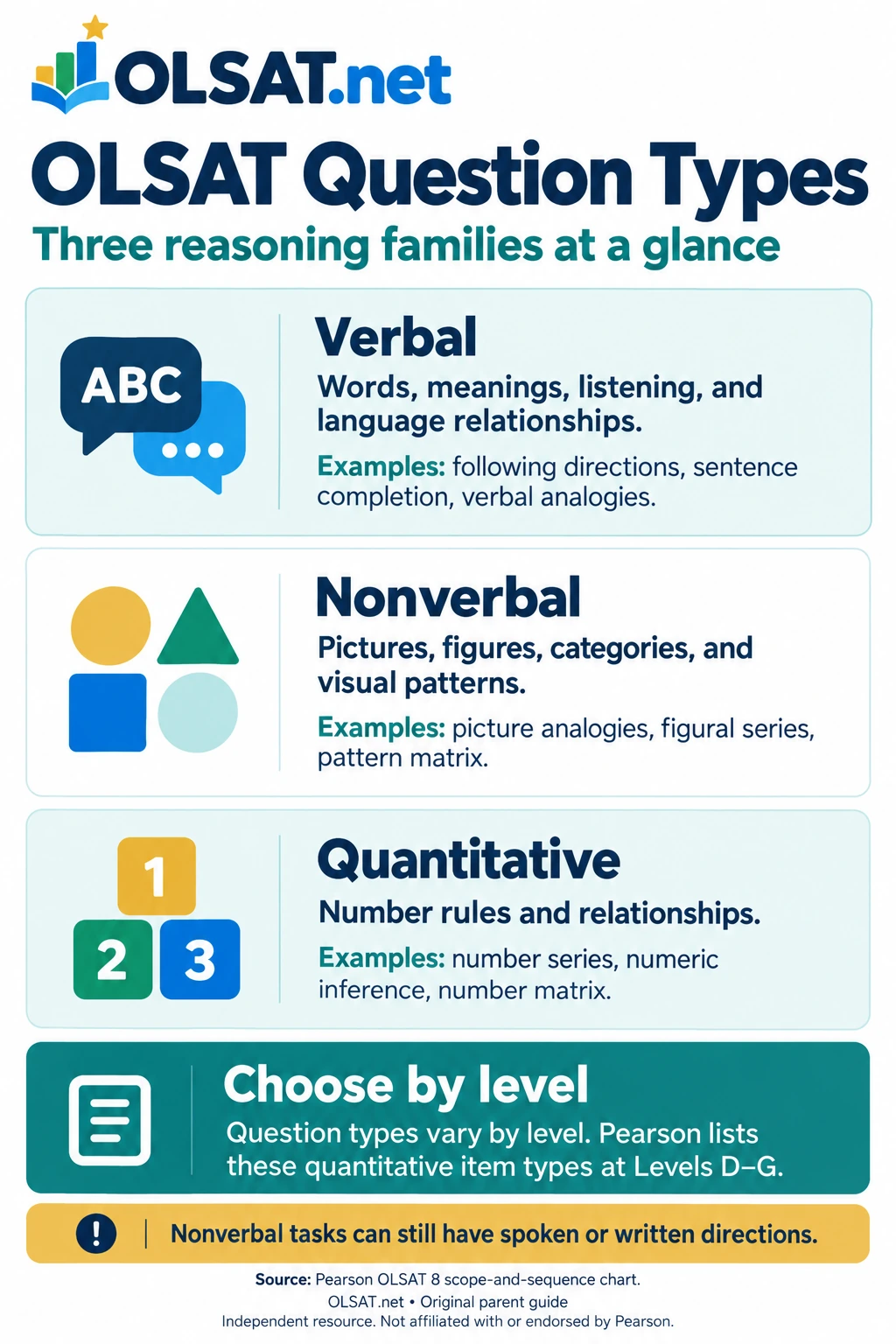
Read OLSAT Question Types Infographic: Verbal, Nonverbal, Quantitative and transcript