
Nonverbal OLSAT questions ask students to reason from pictures and figures. Some tasks use familiar objects; others use abstract shapes, changes, and matrices. A question can still have spoken or written directions, so “nonverbal” does not mean no language is involved in administration.
Picture reasoning
- Picture classification — find the picture that does not fit a category (Levels A–C).
- Picture analogies — transfer a visible relationship (Levels A–C).
- Picture series — continue a repeating sequence (Level A).
Figural reasoning
- Figural classification — compare groups and an outlier (Levels A–D).
- Figural analogies — apply a shape transformation (Levels A–G).
- Pattern matrix — complete a grid rule (Levels A–G).
- Figural series — continue a visual rule (Levels A–G).
How to practice visually
Start by describing what is present. Then isolate one feature at a time: object category, count, shape, size, shading, direction, or position. Check the proposed rule against every figure before choosing. Each linked guide has original diagrams for the question and the answer.
Assessment source: Pearson OLSAT 8 scope and sequence. Examples and illustrations on this page are independently created by OLSAT.net, not publisher items. Your school can confirm its actual level and administration plan.
See the visual reasoning examples
Open the infographic page for a full text explanation, sources, and a downloadable image.
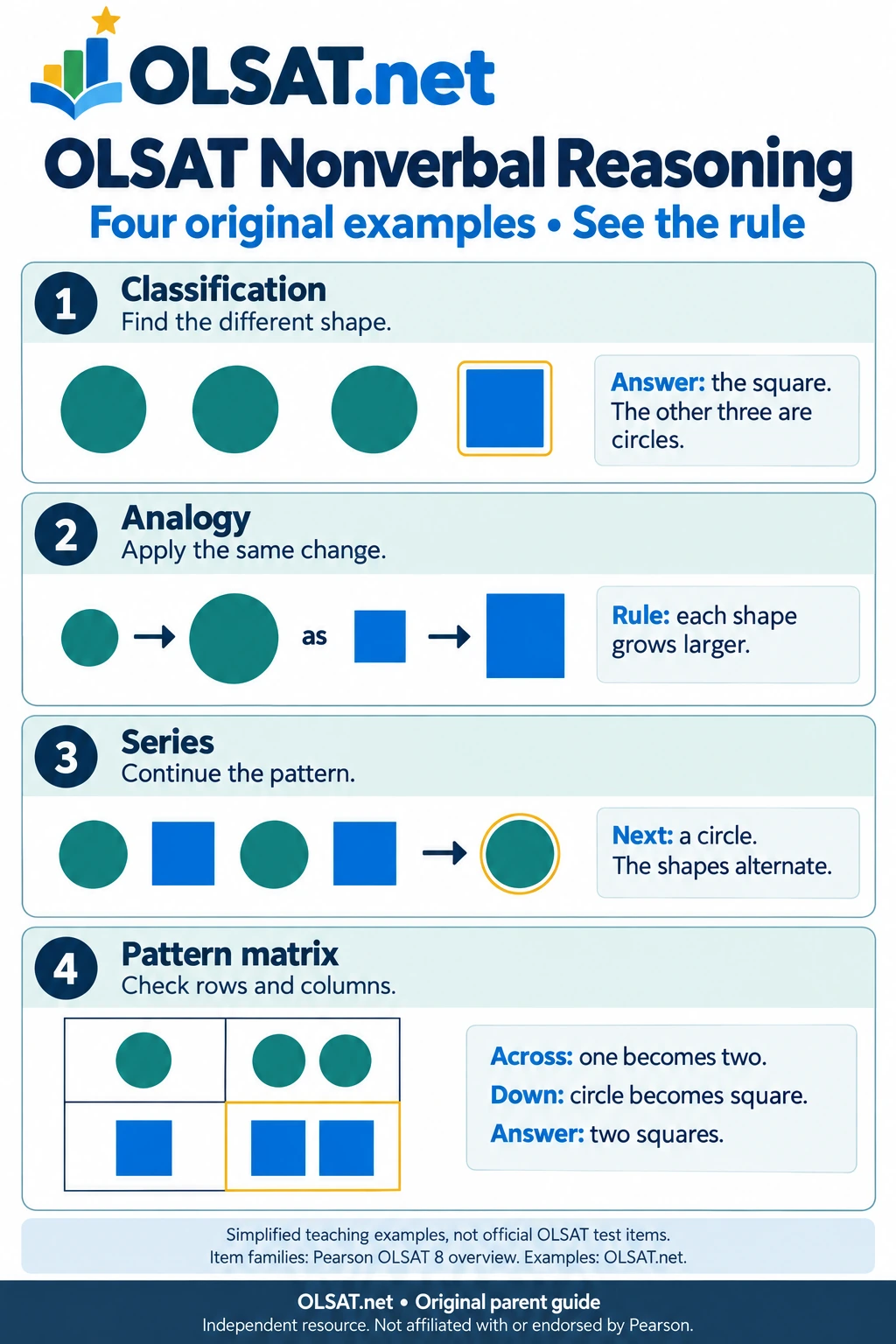
Read OLSAT Nonverbal Reasoning Infographic: Visual Examples and transcript