
Useful preparation begins with familiarity: understanding the directions, recognizing a few task patterns, and feeling comfortable explaining a choice. It does not mean memorizing secure test questions or spending hours on drills.
A practical sequence
- Confirm the actual level and administration details with the school.
- Show one original example of a new question type and think aloud through the rule.
- Let your child try a similar item. Ask, “What changed?” or “What belongs together?”
- Review the explanation kindly, then stop after a short session.
- Try a mixed free practice session once several types feel familiar.
What to avoid
Do not promise a score, turn a practice percentage into a percentile, or suggest that one test defines a child’s ability. Protect ordinary sleep, meals, and routines near test day.
Source: Pearson OLSAT 8 product overview and Pearson OLSAT 8 scope-and-sequence brochure. OLSAT.net is an independent educational resource; examples here are original and are not official test questions.
A skill-first practice routine
For a picture classification item, name the objects and seek a category that fits three. For an analogy, describe the first relationship in a full sentence. For a series, test the rule at every step. For a matrix, check a complete row and then the corresponding incomplete row. These reasoning habits transfer better than memorizing a picture.
When practice feels hard
Return to an easier illustrated example, let the child explain one feature at a time, and end the session before fatigue turns into frustration. Keep school routines, sleep, and reading for enjoyment in place.
See the visual reasoning examples
Open the infographic page for a full text explanation, sources, and a downloadable image.
Read OLSAT Nonverbal Reasoning Infographic: Visual Examples and transcript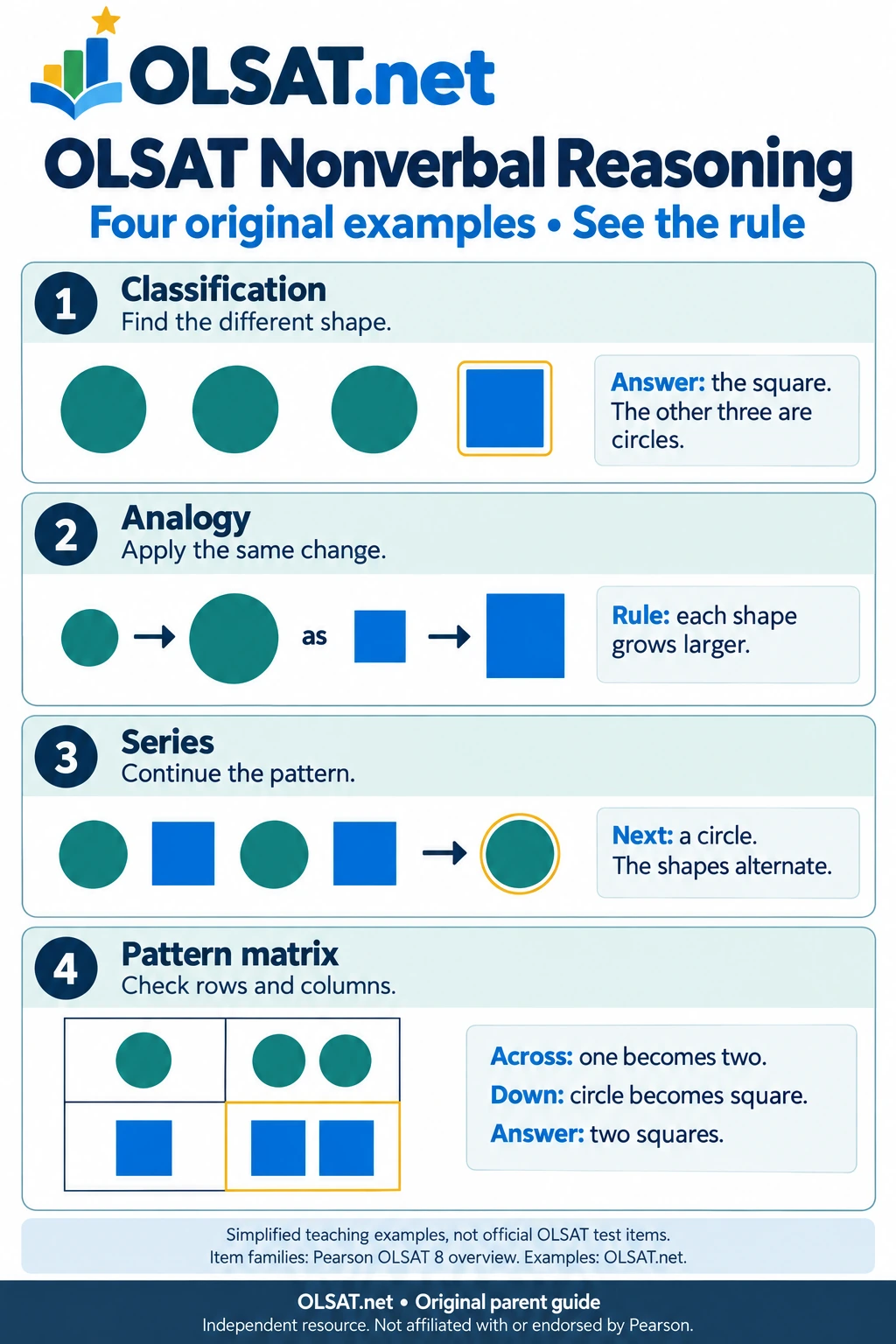
A practical OLSAT preparation sequence
- Confirm the school plan. Write down the test edition, level, date, format, directions, and any approved accommodations.
- Choose matching resources. Use the level chart and grade practice guides. Do not assume that every question type appears at every level.
- Try a short starting set. Our free practice test gives explanations after each answer. Treat the result as a learning snapshot.
- Identify the difficult step. Was the instruction misunderstood, the relationship missed, or a calculation made incorrectly? Each suggests a different review activity.
- Work on one skill. Visit a relevant question-type lesson, discuss the rule, and try a fresh example.
- Return to mixed practice. Ask the child to describe the reasoning without the answer key, then check it against all parts of the problem.
- Finish with normal routines. Confirm practical arrangements with the school and keep preparation calm.
Review mistakes without guessing at an official score
| What happened? | Useful next step |
|---|---|
| One instruction was missed. | Restate the direction and identify each condition before solving. |
| A word was unfamiliar. | Explain its meaning in context, then try a different example using a familiar word. |
| A pattern fit only the first pair. | Check the proposed rule against every step, row, or column. |
| The rule was correct but arithmetic slipped. | Write out the calculation and check it separately from the pattern. |
| The answer was guessed correctly. | Ask for an explanation before counting the skill as understood. |
How much practice should a child do?
There is no universal schedule that suits every student. Begin with a few questions and stop if the child becomes tired or frustrated. Our two-week OLSAT study plan is a flexible family routine, not a publisher requirement. Adjust it to the child and the time available.
What a preparation resource should provide
Look for original questions, clear answer explanations, accurate level guidance, and an honest description of what the practice result means. A resource should distinguish simplified familiarization from a full-length simulation and should not promise gifted placement. The score guide explains why a practice percentage cannot be converted into an SAI.