
OLSAT Level C is typically associated with Grade 2. OLSAT Level C is the typical second-grade level. Listening to relationships, reasoning about short situations, and comparing pictures and figures remain central. Reading ability alone does not describe the reasoning tasks. Confirm the assigned level and form with your school before choosing practice.
OLSAT Level C infographic
Explore the guide together, then try the four original examples. Open the full-size image to read the smaller details; the key information and explanations are also available as text below.
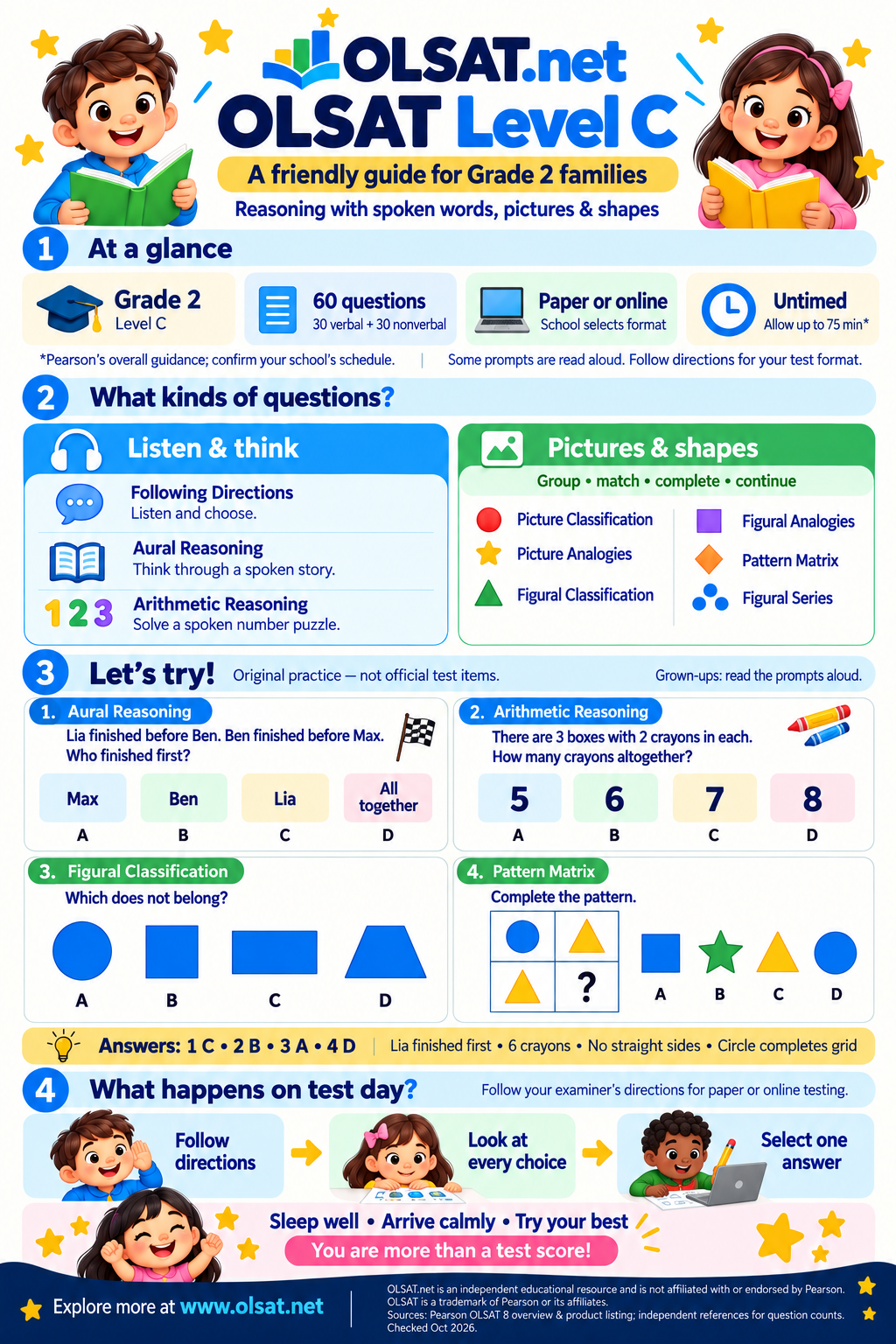
Open the full-size Level C infographic · Compare all OLSAT levels
Level C format, question count, and timing
- Typical grade match: Grade 2.
- Commonly reported length: 60 questions, with 30 verbal and 30 nonverbal.
- Delivery: Paper or online; ask the school which format and directions apply.
The infographic uses Pearson’s general untimed guidance, allowing up to 75 minutes. Second-grade school schedules may divide the administration into separate sittings; confirm the plan and the directions for your child’s format. The infographic’s counts are commonly reported preparation figures, not a verified specification for every current official form. Our question-count and timing FAQ explains the source differences and practice settings.
What question types are included at Level C?
Verbal reasoning and comprehension
Following Directions · Aural Reasoning · Arithmetic Reasoning.
Have your child track the order of events, separate relevant details from a spoken story, and check both rows and columns in a simple visual grid. Say the relationship aloud before choosing an answer.
Nonverbal reasoning
Picture Classification · Picture Analogies · Figural Classification · Figural Analogies · Pattern Matrix · Figural Series.
Compare categories, positions, sizes, and visible changes. Nonverbal questions can still involve spoken directions; the term describes the reasoning task. The list follows the publisher’s level scope rather than equal quotas for each type.
The infographic’s four examples explained
These simplified, independently created examples teach a method. They do not reproduce secure OLSAT questions or represent the full difficulty range of a test form.
- Aural reasoning: Lia finished before Ben. Ben finished before Max. Who finished first? Answer C. The order is Lia, Ben, Max, so Lia finished first.
- Arithmetic reasoning: There are 3 boxes with 2 crayons in each. How many crayons altogether? Answer B. Three groups of two make six: 2 + 2 + 2 = 6.
- Figural classification: Which does not belong: circle, square, rectangle, or trapezoid? Answer A. The circle has no straight sides; the other three shapes do.
- Pattern matrix: A two-by-two grid has circle–triangle in the first row and triangle–blank in the second. What completes the alternating pattern? Answer D. A circle completes the second row and the second column with one of each shape.
How to prepare for OLSAT Level C
Use one listening example and one visual example in a short session. Let your child explain a choice before reviewing the answer. If the school uses online delivery, practice selecting one option comfortably without adding speed pressure. Begin without a timer so the reasoning is clear. If you later use a timed OLSAT.net simulation, remember that its countdown is a practice setting rather than a universal official limit.
Start with free practice and select Level C. For structured member practice, explore grade-based OLSAT Practice Passes. Families with an assigned pass can continue from My Practice. Grade 2 preparation guide.
Before test day
- Confirm the level, form, paper or online delivery, and how directions will be presented.
- Ask about the session length, breaks, materials, and any agreed accommodations.
- Keep normal sleep and meal routines; leave time to arrive calmly.
- Encourage careful listening or reading, checking every choice, and selecting one answer as instructed.
Common Level C question
Does Level C include Number Series?
Pearson’s scope chart starts Number Series, Numeric Inference, and Number Matrix at Level D. Level C includes Arithmetic Reasoning in the verbal domain, which should not be confused with those later quantitative categories.
A practice percentage is a learning snapshot. To understand the school’s report, read our OLSAT scores guide and ask how local decisions use the results.
Sources and review: Grade matches and question-type scope: Pearson OLSAT 8 overview brochure. General format and untimed guidance: Pearson product overview. Commonly reported counts: TestPrep-Online’s independent count table. Administration planning: University of Missouri administration guide. Reviewed October 7, 2026. OLSAT.net is independent and is not affiliated with or endorsed by Pearson.