
Pick the level that matches your child’s school plan. Each ten-question session includes independently written learning exercises and an explanation after every answer. The result describes only this small set; it cannot predict an official score or placement decision.
For younger students, an adult may read directions aloud and help with the controls. There is no countdown clock and no account or email requirement.
How to use the result
Notice the question families that felt unfamiliar. Read the explanations together, then visit a related lesson. Confirm the school’s exact level and format rather than treating this activity as a full simulation.
Source: Pearson OLSAT 8 product overview and Pearson OLSAT 8 scope-and-sequence brochure. OLSAT.net is an independent educational resource; examples here are original and are not official test questions.
What the illustrated questions show
For picture and figural items, study the question diagram and each answer figure before selecting an option. After checking, compare the highlighted answer with the full explanation. The nonverbal guides offer more step-by-step practice with the same visual approach.
Choose an OLSAT practice level by grade
The chart below follows Pearson’s typical OLSAT 8 level matches. Your school’s assigned level takes priority. The A–G buttons above start our ten-question learning sessions; the grade guides contain additional examples you can read without starting the interactive test.
| Grade | Level | Practice guide |
|---|---|---|
| Kindergarten | A | Kindergarten sample questions |
| Grade 1 | B | 1st grade sample questions |
| Grade 2 | C | 2nd grade sample questions |
| Grade 3 | D | 3rd grade sample questions |
| Grades 4–5 | E | 4th grade and 5th grade questions |
| Grades 6–8 | F | 6th grade, 7th grade, and 8th grade questions |
| Grades 9–12 | G | High-school practice questions |
Three original OLSAT-style examples with explanations
These simplified examples show how to discuss a reasoning rule. They are not official test items, and they do not establish the difficulty or question mix of an administered OLSAT form.
Early-grade following directions with pictures
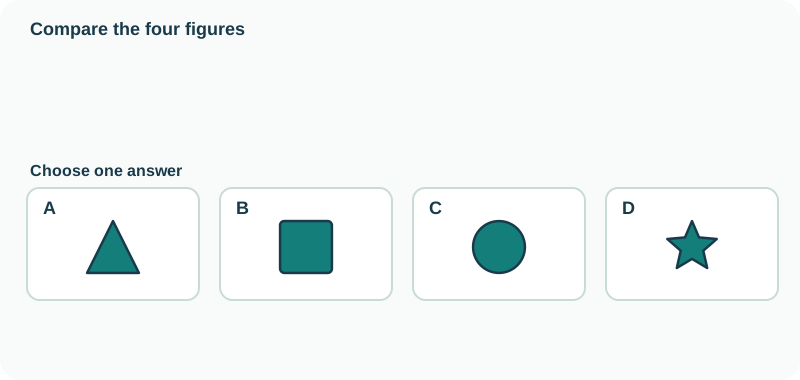
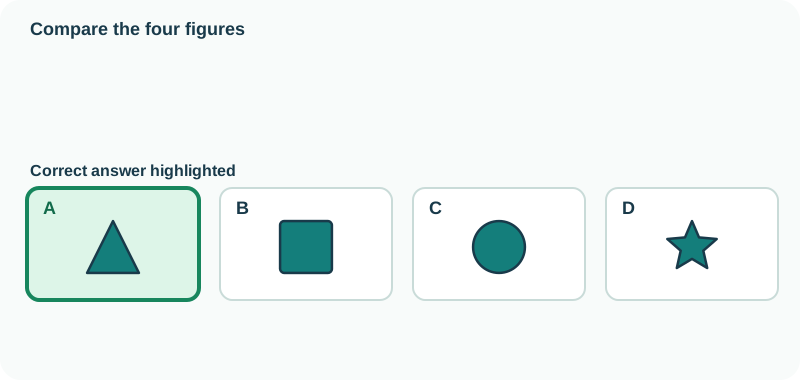
An adult may read: “Point to the shape that has three sides.”
Show the answer and visual explanation
Answer A: ▲ Triangle. A triangle has three straight sides.
Level D–G number series example
What comes next: 7, 12, 17, 22, __?
A. 25 B. 26 C. 27 D. 29
Answer: C, 27. Each step adds 5. Check every transition before applying the same rule to 22. See the number series lesson for more ways to check a pattern.
Level D–G verbal analogy example
Wheel is to bicycle as page is to __.
A. Book B. Pencil C. Writer D. Desk
Answer: A, book. A wheel is part of a bicycle; a page is part of a book. A writer may use a page, but that is a different relationship. Explore the verbal analogy lesson.
Is this a full-length OLSAT practice test?
No. Each interactive level session is a short, untimed set of ten original questions. It is designed for familiarization and discussion, not to reproduce a secure assessment, generate an official score, or provide a full-length simulation. Check the test format guide and ask the school about its actual administration.
Can I print the practice resources?
The grade guides and question-type lessons can be printed from your browser. The printable OLSAT starter chart includes grade matches and a parent checklist. Interactive selections do not become a standardized paper test when printed.