
This original OLSAT.net visual guide gives families a quick starting point. The full explanation is below the image for accessibility and additional context. For a sharable reference, link to this page so readers can see the transcript, sources, and current version.
Read OLSAT Nonverbal Reasoning Infographic: Visual Examples and transcript · Download full-size PNG
Four visual examples explained
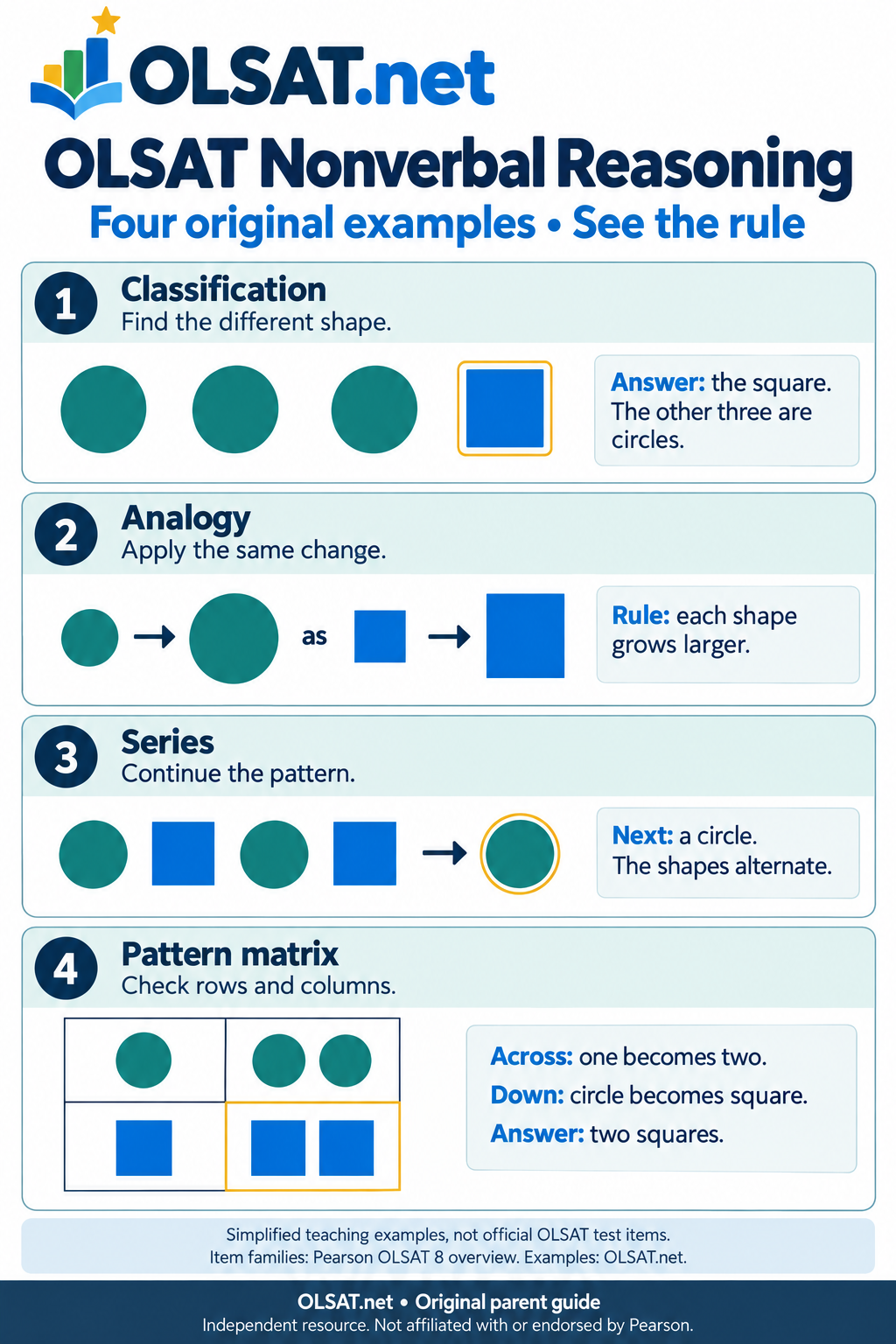
1. Classification
Three teal circles share one shape. A blue square is different. A useful habit is to say the common property aloud before selecting an answer. In a real question, check every choice against the same rule.
2. Analogy
A small circle becomes a larger circle. Apply the same size change to a small square to get a larger square. Look for the single change that works on both sides.
3. Series
The order alternates circle, square, circle, square. The next figure is a circle. Confirm the sequence repeats before choosing.
4. Pattern matrix
In this two-by-two illustration, moving right changes one shape to two of the same shape. Moving down changes circles to squares. The bottom-right cell therefore contains two squares. Check both row and column rules.
Pearson’s scope chart includes picture and figural item families at different levels. The nonverbal hub links to seven detailed guides with original diagrams and visual answer explanations. The simplified figures here teach a reasoning habit and do not reproduce secure test content.
Source and editorial note
Item-family terminology and level scope checked against Pearson OLSAT 8 overview brochure; all figures and examples are original.
OLSAT.net is an independent educational resource and is not affiliated with or endorsed by Pearson. Schools determine actual testing and placement decisions.
Keep learning
Study the illustrated nonverbal guides · Try the free visual questions