
This original OLSAT.net visual guide gives families a quick starting point. The full explanation is below the image for accessibility and additional context. For a sharable reference, link to this page so readers can see the transcript, sources, and current version.
Read OLSAT Question Types Infographic: Verbal, Nonverbal, Quantitative and transcript · Download full-size PNG
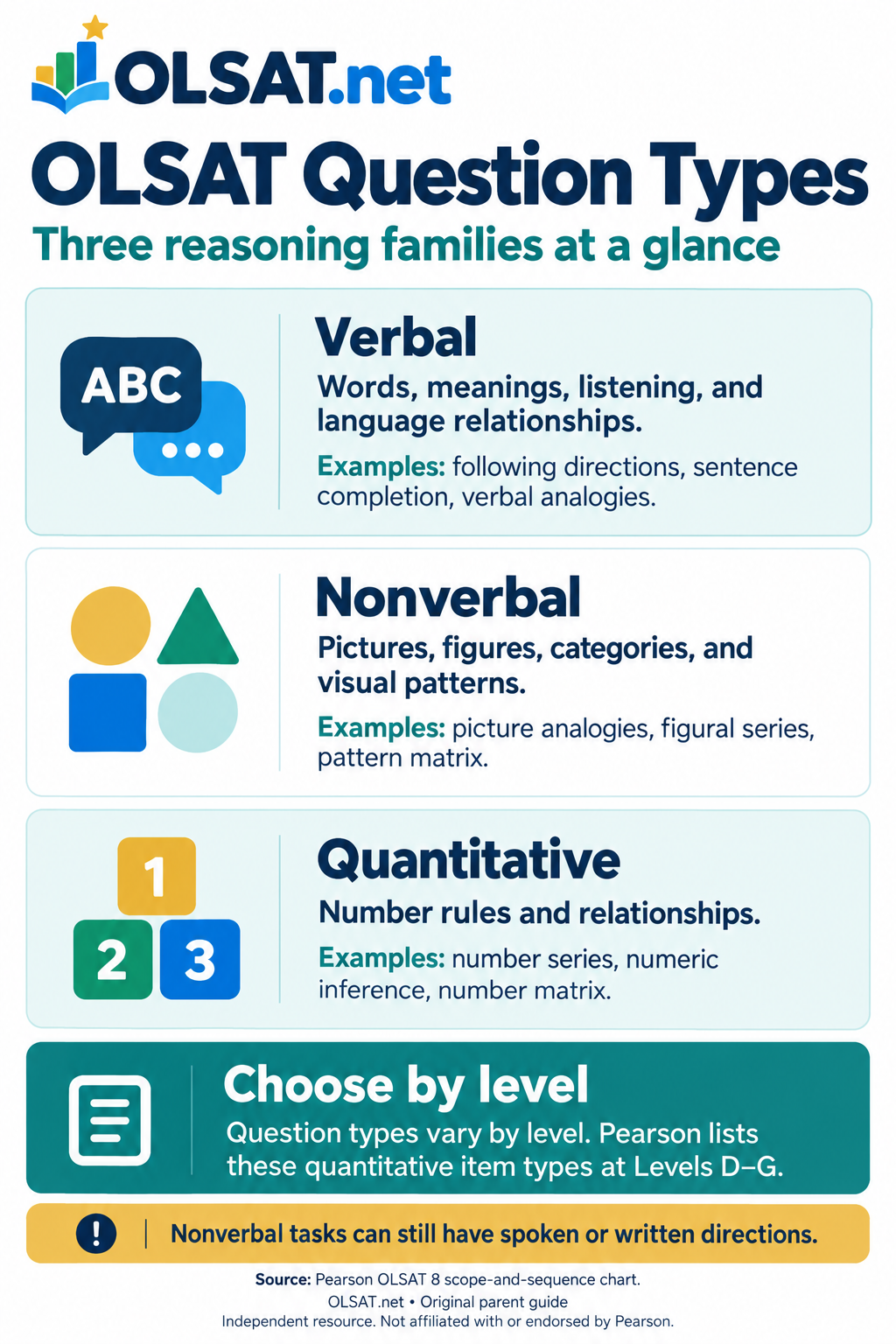
Three reasoning families in text
Verbal reasoning
Students reason with spoken or written language, word meanings, and relationships. Examples include following directions, sentence completion, and verbal analogies. The exact task depends on the child’s level and how the school administers the test. Explore our verbal question-type guide.
Nonverbal reasoning
Students compare pictures and abstract figures, look for categories, transfer changes, or complete sequences and matrices. Examples include picture analogies, figural series, and pattern matrices. Nonverbal items may still require oral or written directions. See the illustrated nonverbal guides.
Quantitative reasoning
Students identify number rules and relationships. Pearson’s scope chart lists Number Series, Numeric Inference, and Number Matrix at Levels D–G. Start with our quantitative guide.
Source and editorial note
Reasoning families and level scope checked against Pearson OLSAT 8 overview brochure.
OLSAT.net is an independent educational resource and is not affiliated with or endorsed by Pearson. Schools determine actual testing and placement decisions.